NEOPRENE FACTORY: HUNAN TIANCHI POLYMER NEW MATERIAL CO., LTD.
Language:
 ∷
∷

∷
 ∷
∷
When you possess a priceless Stradivarius violin, laden with emotion and history, or a German handmade cello with a rich, mellow tone that has been your companion for years, doesn't every move, every transport, and even every brief moment of storage make your heart leap into your throat? Have you ever endlessly imagined those terrifying moments: an accidental drop during baggage handling, the constant vibration on a bumpy tour bus, or just a casual bump backstage? Could these seemingly minor risks inflict irreversible damage on your beloved instrument?
For every musician who cherishes their instrument, is an instrument bag or case merely a "container"? No, it should never be just that. It should be an extension of your instrument's life, a formidable fortress against all potential external threats, a silent yet reliable "shockproof expert." However, can the dazzling array of instrument bags on the market truly fulfill this role? Can those seemingly thick paddings really absorb and dissipate impact forces effectively, instead of failing at the critical moment? When you open a standard instrument bag and see that the filling is ordinary polyurethane foam (PU Foam) or polyethylene foam (EPE), don't you question whether such a lightweight material can truly guard a masterpiece that embodies centuries of craftsmanship and your countless hours of effort?
It's time to end this compromise and anxiety. Today, we will delve deep into a material revered in the global high-end protective gear industry—CR foam, also commonly known as Chloroprene Rubber or Neoprene. We will use a series of irrefutable facts and rhetorical questions to reveal why CR foam is the one and only, the ultimate answer to protecting your expensive string instrument accessories. Don't you want to know what scientific principles and manufacturing processes are hidden behind this, granting it such extraordinary protective capabilities?
Part 1: Unveiling the "Shockproof Expert"—What Exactly is CR Foam?
Before diving into its applications, we must first answer a fundamental question: what exactly is CR foam? And how does it differ from the cheap foam materials we commonly encounter?
CR foam, with the chemical name Chloroprene Rubber Foam, is a synthetic rubber produced through the emulsion polymerization of chloroprene monomers. Sounds highly technical, doesn't it? But it's precisely this unique chemical composition that endows it with an unparalleled set of physical properties. Imagine the internal structure of CR foam as being composed of countless tiny, independent, sealed air bubbles (what we call a closed-cell structure) packed tightly together. This is worlds apart from many common foams (open-cell structures).
Don't you think this closed-cell structure is the very source of its superior performance? Each sealed bubble acts like a miniature, gas-filled shock absorber. When an external impact force strikes, these millions of "micro-airbags" work in concert to rapidly absorb the intense, concentrated force and distribute it evenly throughout the material. Isn't this process like a highly disciplined army, neutralizing a fierce enemy attack and rendering it harmless? In contrast, open-cell foams allow gas to easily flow from one cell to another under pressure, leading to structural collapse and allowing the impact to pass almost directly through. Isn't this a potential betrayal of your instrument?
The Core Composition of CR Foam and Our Manufacturing Expertise
A top-tier CR foam shockproof insert is far more complex than you might imagine. It is not just a simple "piece of foam." As a manufacturer deeply rooted in the field of CR foam products for many years, we understand its secrets intimately.
The Core CR Foam Layer: This is the cornerstone of all protection. We don't offer a single type of CR foam. Instead, based on the specific instrument (like a violin, viola, cello, or classical guitar), its weight, its most vulnerable parts, and the client's specific needs (e.g., for air cargo or daily carry), we provide CR foam of varying hardness, density, and thickness. Would you use the exact same material for a lightweight Baroque violin and a heavy double bass? Of course not. Through precise calculations, we recommend the most suitable CR grade to ensure optimal cushioning performance while providing adequate support.
Surface Lamination Fabric: While the raw surface of CR foam is functionally powerful, direct contact with a precious instrument's varnish could cause micro-abrasions. Therefore, we laminate its surface with various functional fabrics. Have you ever considered that the choice of lining is also a science? We can laminate it with soft and smooth Lycra, plush Velvet, or even special anti-static fabrics to ensure that while your instrument enjoys top-tier shock protection, its finish is also treated with the gentlest care. For the outer layer, we can laminate wear-resistant Nylon or Polyester fabric to enhance the durability and structural integrity of the entire insert. Isn't a protective solution that excels both inside and out exactly what you're looking for?
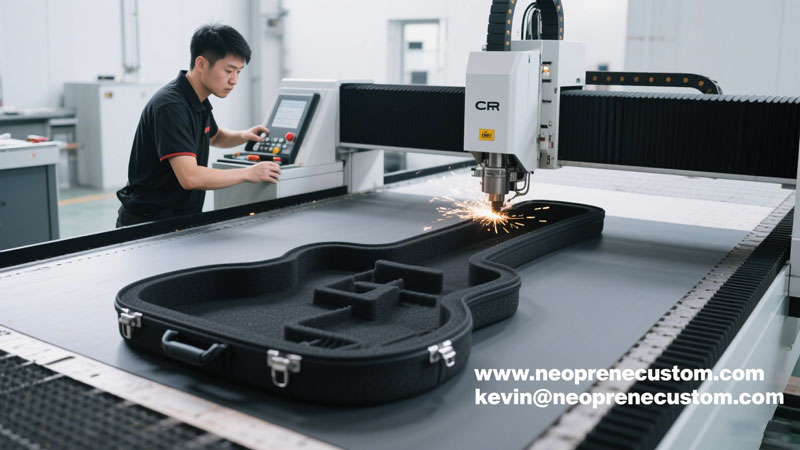
Precision Cutting and Molding Process: Once you have the best material, how do you shape it to perfectly fit the contours of your instrument? This is precisely our core competency as a professional manufacturer. We possess advanced CNC (Computer Numerical Control) cutting equipment and high-precision compression molding technology. You only need to provide the dimensional data of your instrument, or even a 3D model, and we can precisely cut and mold a solid block of CR foam into a bespoke "cradle" that fits your instrument, bow, rosin box, and other accessories flawlessly. Can you imagine? When your instrument is placed in our custom CR insert, it will be held securely in place, eliminating any possibility of movement inside. Isn't this unwavering sense of security priceless?
We, at neoprenecustom.com, are exactly this type of manufacturer specializing in custom orders for all kinds of CR foam products. We pride ourselves not just on providing high-quality CR foam raw materials, but on offering a one-stop solution from material selection and structural design to precision manufacturing. Want to discuss a custom protection plan for your instrument? Why not send an email directly to kevin@neoprenecustom.com and have an in-depth conversation with our technical expert, Kevin?
Part 2: Why Must It Be CR Foam? An Unavoidable Performance Showdown
Perhaps you might ask, there are other foams like EVA and XPE on the market, aren't they also commonly used for packaging and protection? Why are we so insistent that CR foam is the only choice for string instrument protection? Let's have a performance duel using a series of pointed rhetorical questions.
On Shock Absorption and Cushioning: EVA foam does have a certain elasticity, but isn't its rebound performance a bit too "stiff"? After an impact, it "bounces" some of the energy back, potentially causing secondary micro-vibrations to the instrument. The energy absorption of CR foam, however, is like the gentle push of Tai Chi; it "dissipates" rather than "resists." It more effectively converts impact energy into heat. Isn't this blend of firmness and gentleness more suitable for delicate and fragile string instruments?
On Weathering and Durability: Does your touring schedule take you across different climate zones? From humid Southeast Asia to the dry North American interior, drastic changes in temperature and humidity are a huge test for protective materials. Aren't common foams prone to aging, becoming brittle, or even powdering under UV light and extreme temperatures? CR foam, on the other hand, is renowned for its excellent resistance to weathering, ozone, chemical corrosion, and aging. It maintains its physical properties stably over the long term in a variety of harsh environments. Do you really want the "heart" of your instrument case to fail after a few years, exposing your instrument to risk all over again? Isn't choosing CR foam choosing long-term peace of mind?
On Water and Air Tightness: Remember the closed-cell structure we mentioned? This structure gives CR foam its natural water and air resistance. If you accidentally spill water on your instrument case or have to run through the rain, don't you want the protective insert to act as a waterproof barrier, keeping moisture out and protecting the wood of the body and the strings from humidity damage? Once an open-cell sponge absorbs water, it not only becomes incredibly heavy but also a breeding ground for mold. Isn't that a disaster for an instrument?
On Flame Retardant Safety: In professional settings like recording studios and concert halls, isn't fire safety a factor that cannot be ignored? CR foam itself has excellent flame-retardant properties; it is self-extinguishing when removed from a flame. Many other types of foam are not only flammable but can also release toxic gases in a fire. When considering a comprehensive protection plan, shouldn't this potential safety hazard also be eliminated?
After this series of comparisons, is the answer not self-evident? In the critical domain of protecting expensive string instruments, any compromise in performance can lead to irreparable consequences. Isn't choosing CR foam the most rational and professional decision?
Part 3: Beyond Off-the-Shelf—Customization is the Highest Tribute to a Work of Art
Now, let's return to the initial question: do you really think a "one-size-fits-all" instrument case, made for mass production, can perfectly match your unique, one-of-a-kind instrument?
Every handmade, high-end string instrument has subtle differences in its curvature, dimensions, and weight distribution. A 1715 "Titian" Stradivarius and a 1741 "Vieuxtemps" Guarneri del Gesù might only differ in their contours by millimeters, but it is these very differences that determine their posture within the case. A standardized insert will inevitably have gaps in some areas and improper pressure in others. Isn't this "ill-fitting" protection a form of potential, continuous harm?
This is where we, as a professional CR foam custom manufacturer, find our purpose.
Do you need a groove specifically designed for the unique scroll of your "del Gesù"? We can do that.
Do you need to reserve a precise space with extra cushioning for your French-style bridge? We can do that.
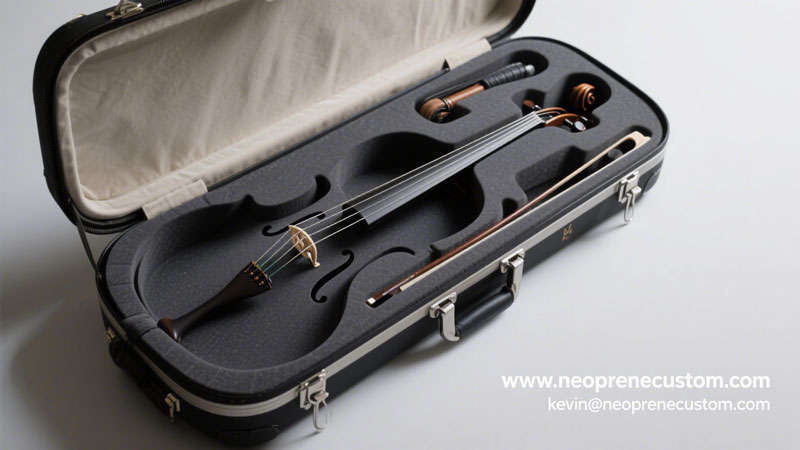
Do you need an integrated insert for your tour that houses your instrument, spare strings, tuner, shoulder rest, and rosin, with each item having its own dedicated CR foam slot? This is our specialty.
What is our customization process like? It's simple and efficient. You can contact our expert Kevin via email (kevin@neoprenecustom.com), providing the brand/model of your instrument, photos of key areas with dimensions, or even just a preliminary idea. Our team will discuss with you, from selecting the density of the CR foam to choosing the color of the lining fabric and planning the internal layout. Every detail can be tailored to your wishes. Want to see some of the stunning creations we've made for other musicians? Feel free to visit our official website at https://neoprenecustom.com. The case studies there might give you more inspiration.
For a priceless work of art, isn't equipping it with a completely bespoke "personal bodyguard," tailored from the inside out, the most fundamental respect and the ultimate expression of care?
Conclusion: Stop Gambling with Your Beloved Instrument
In review, we have repeatedly argued from the perspectives of scientific principles, material composition, performance comparison, and customization advantages for one core point: when it comes to protecting expensive string instrument accessories, CR foam (Chloroprene Rubber) is not just "one of the options," it is "the only correct choice."
Are you still hesitating, still using those seemingly thick but fragile standard instrument cases?
Are you still on edge every time you travel, praying that no accidents happen?
Have you realized that providing top-tier protection for your instrument is, in itself, the wisest and most worthwhile investment?
Don't let your precious instrument be subjected to mediocre protection any longer. Isn't now the perfect time to take action and find a true "shockproof expert" for it?
We are not just producers of CR foam; we are the architects of your instrument's safety, the guardians of your musical dreams. We possess the core materials that define the standards of protection, master the precision craftsmanship to achieve a perfect fit, and share the same boundless reverence for the art of music as you do.
Take action now. Visit https://neoprenecustom.com to learn more about our technology and case studies. Or, more directly, put your needs and concerns into an email and send it to kevin@neoprenecustom.com. Let our expertise put an end to your worries. After all, when the stage lights come on, you need to focus on delivering the most perfect music, not worrying about whether your instrument is safe backstage, right?
Contact: Kevin
Phone: 13417385320
Tel: 0734-87965514
Email: kevin@neoprenecustom.com
Add: Intersection of Zhangjialing Road and Science and Technology Road, Guiyang Industrial Park, Guiyang Town, Qidong County, Hengyang City, Hunan Province./Dongguan Factory(GUANXIN): Shixin Street, Fushan Village, Liaobu Town, Dongguan, Guangdong Province.
 Kevin
Kevin Kevin
Kevin
 Tianchi